Thursday, 8 December 2011
Gone with The Wind
No sign of the Pallid Harrier on two subsequent visits to Ferry Road (although the Short-eared Owl was out hunting and gave great views), so perhaps it was just passing through... Very strong winds yesterday and today will have undoubtedly helped it on its way. Meanwhile, had a brief glimpse of a Water Rail swimming across the Gadder at the bridge yesterday morning. Only the second time I've seen one in Oxborough, but they're so elusive that it's hard to believe there aren't more lurking out there.

Wednesday, 30 November 2011
Raptor Fest at Oxborough Hythe
A bright late afternoon and so off down Ferry Road in search of a short-eared owl with SP... Haven't been down there for months, possibly a year or more, but nothing much has changed. On the way down I thought I saw a short-eared owl quartering the meadow around where I saw the crane two years ago, but it disappeared out of sight and then a surprisingly dark barn owl popped out much closer, and flew across. The track along the river was passable but no birds on the river itself, only a kestrel flushed out of the trees there. Set off then across the meadow towards the pumping station (still standing!), putting up a couple of snipe and then a beautiful shortie appeared, busy hunting up and down, perching on a post and heading straight towards us on a couple of occasions. On one swoop it seemed to catch a mole. Great to see, and let's hope it stays for the winter! As we walked back, a possibly second barn owl appeared - this one seemed paler than the bird we'd seen earlier - and then a ringtail harrier, its white rump gleaming in the gloom. As it came closer, its very ginger-coloured underparts became clear, and the noticeably sooty underside of its secondaries.... Pallid??? Need to go back tomorrow and try and see the diagnostic collar that the books tell me is required for a conclusive ID.
Monday, 5 September 2011
The Beauties of the Branch Line
Autumn wind and fitful sunshine, so off to Narborough with SP in search of gentians. Clustered bellflower or autumn gentian, it's the issue dividing the country right now. For several years I thought these were one and the same when they are CLEARLY not! The ones at Foulden Common are bellflowers, but those at Narborough railway reserve are autumn gentians, the real thing, Gentianella amarella - a chalk grassland specialist. At Narborough they grow in the short sward either side of the main path, and plenty of them. Some were already over, others yet to come but it seems that each spike never has more than two or three individual blooms in flower at any one time.


Gentian spike

Close up of individual flower
And here's a Clustered Bellflower, so make no mistake!

Plenty of other flowers still in bloom, scabious, both greater and lesser knapweed, lady's bedstraw, restharrow, wild marjoram, plus carline thistles and impressive displays of guelder rose berries.


Despite the conditions, quite a few butterflies were out and about. Three or four red admirals, a lone small tortoiseshell, several speckled woods, one or two green-veined whites, a single small copper, two common blues (1m, 1f) and a rather battered small skipper.
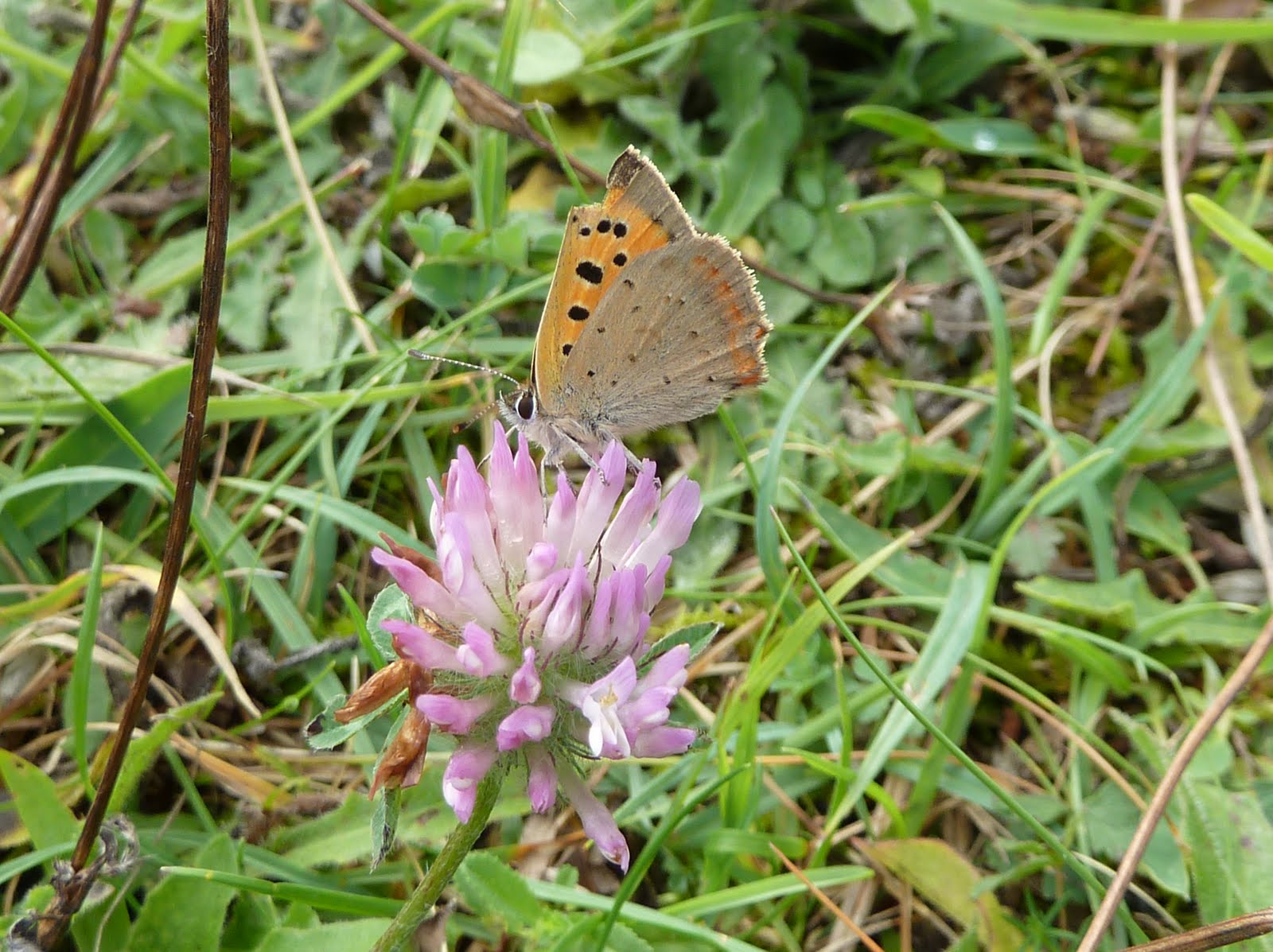
A rather tatty looking Small Copper...

...and an equally ragged Small Skipper

Harebells galore along the embankment

Monday, 15 August 2011
The Magic of Hickling
With summer fast running out, it seemed the right time to go to Hickling once more and pay homage to Emma Turner on the centenary of her rediscovery of the bittern there. Hickling = Maurice Millard and his boat, and so we set off in the late afternoon with Maurice at the helm. It felt very August - muggy and dark green - and there was a regatta on at the sailing club, but once out on the broad we were virtually alone. We glided across, the wind dropping all the while, and had a look at Rowland Green's last studio (where we stayed) and then at his original place, the one in the mill. As we did so, a bittern suddenly flew above us, only a few metres away, before landing in the reedbed on the far side of the broad. Fantastic views! And perhaps the Spirit of Emma T? Then we paused next to her island, looked at some pictures of her which Maurice had found at Whiteslea Lodge and read a little from Broadland Birds. Maurice had actually been onto the island a day or two before and found an old gatepost in the undergrowth - unsure what this might be, as no remains left of her hut. He recalled how (not sure when) he had met a chap who had "celebrated" his 21st birthday in the remains of the hut, probably in the 1970s - holes in the walls and plants poking through then, apparently. Clearly the structure had deteriorated since the pic Maurice found on googlearth of two holidaymakers sitting outside it in the 1960s.... Anyway, it was good to commune with ET again. Saw some good birds later: marsh harriers, a hobby, wood sandpipers, blacktailed godwits and hundreds of teal. Plus an outrageous sunset to end on. There is something very special about Hickling and its broad; I can see why it captured ET.


Wednesday, 20 July 2011
A Grisly Ending?
After the euphoria (well, sort of...) of yesterday when the two young doves left their natal rosebush and moved to the mirabel tree down the drive came some bad news this morning. An array of collared dove feathers in the middle of the drive - a visit by Mr or Mrs Sparrowhawk. Sad, but hopefully the young dove is now sitting inside some baby sparrowhawks and so playing its role in the glory that is the ecosystem!


Carnage on the drive! One young dove down, but hopefully number 2 is still out there...
Friday, 15 July 2011
The World's Most Useless Nest Appears to Triumph

The nest is located just to the top right of the door
After weeks of scorn and ridicule, the flimsy platform of twigs in the rose bush outside the front door is about to make us eat our words. It's probably five weeks or so since a female collared dove appeared there, clamped on her apology of a nest and refusing to be bothered by any of the comings and goings at number 24. Her mate made only the rarest of appearances and, apart from one glimpse of an egg, which was about to fall out of the nest and had to be prodded back in by me, there was no evidence of anything going on underneath her. Until last week, when suddenly she had two large chicks, complete with feathers and looking exceedingly well cared-for. Precisely how this had happened without us noticing remains unclear, but today the youngsters are sitting outside the nest and looking as though their departure date cannot be far off...

Sitting tight, waiting to grow up.

One chick ventures out of the nest, but no sign of any wingflapping yet.
Wednesday, 6 July 2011
After the Emperor
An impromptu expedition to the land of the Purple Emperor took Sue P and I to just beyond Peterborough, to Bedford Purlieus - a national nature reserve run by English Nature and the Forestry Commission. It's an amazing tract of ancient woodland, full of magnificent trees and reputedly the home of the Emperor... Typically, a hot sunny day in Oxborough had slid into a muggy overcast one at BP, but even so we were in for some real treats.


A network of rides dissects the forest, with great plants and butterflies along many of them.
First up was a whole patch of herb paris, just after going through the entrance:

From then on it was great plants all the way, very diverse rides full of classic wayside flowers but also with some more unusual stuff, like nettle-leaved bellflower:

We also found a magnificent plant of Atropa belladonna, Deadly Nightshade, just coming into flower and the "Death Cherries" just starting to form:


The sun managed to burn through the cloud a bit and things really warmed up - lots of butterflies soon around, hundreds of meadow browns and ringlets, plenty of large skippers too. Then a single marbled white in one of the more open grassy areas, a lone small heath and several brown arguses:

Then the first of several silver-washed fritillaries raced by - they must be the fastest-flying of all the British butterflies, but as the sun came through they increasingly settled:

Lifting up pieces of corrugated iron left in the grassy areas produced four slow-worms under one and these two under another - lefthand individual at least 18 inches long!

Subscribe to:
Posts (Atom)